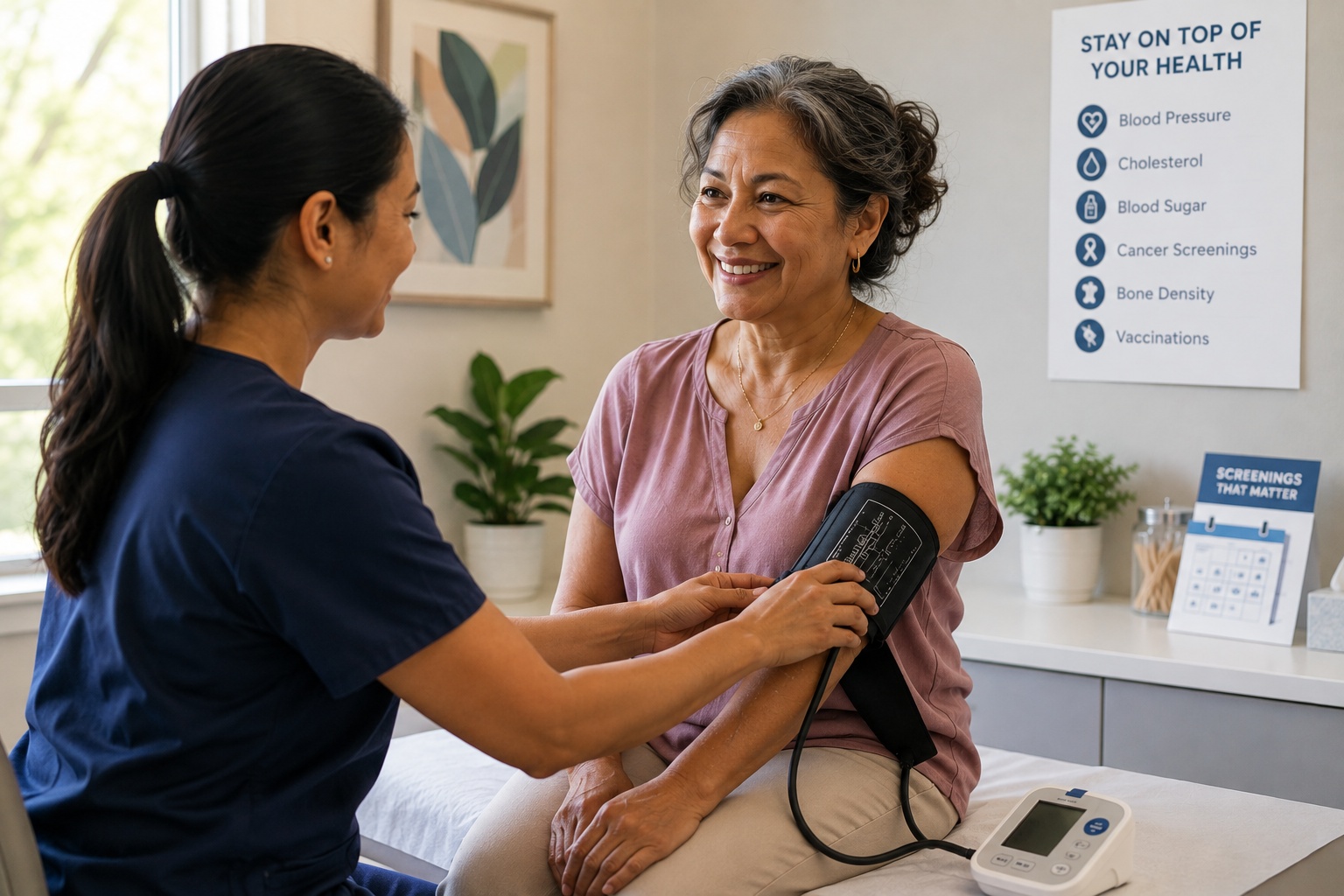

Short answer: fewer than you’d think, and probably not the ones you’re worried about.
There’s a lot of noise out there. Full-body scans. Fifty-marker blood panels. Somebody on the internet insisting you need a test your doctor has never mentioned. Meanwhile, you just want to know what actually matters.
So here’s a straightforward roadmap. Think of it as a map, not a to-do list. Not every woman needs every test here. But knowing what exists means you can walk into your next visit and ask for what you need.
If you’d rather talk it through with someone who has time, book a women’s health consultation. We can build your plan together.
Key takeaways
- A handful of simple checks catch most of what matters: blood pressure, cholesterol, blood sugar, and a few cancer screenings.
- More testing isn’t better testing. Extra tests often lead to more tests, more worry, and no better health.
- Your family history can change your timeline. Bring it up.
- If you still get periods, ask about your iron. Low iron is common, and it’s easy to miss.
- Mammograms generally start at 40. Colon screening starts at 45. Cervical screening starts at 21.
- Screening finds problems before you feel them. That’s the whole point.
Why does midlife change what I need?
A few things shift at once.
First, your body changes. As estrogen drops during perimenopause and menopause, cholesterol tends to creep up, bone loss speeds up, and blood sugar can drift.
Second, age itself matters. Most cancers become more likely as you get older, no matter how healthy you feel.
Third, and this is the encouraging part, most of these changes are quiet. High blood pressure doesn’t hurt. High cholesterol doesn’t either. Early bone loss is completely silent. That’s exactly why we check.
You don’t need to feel unwell to benefit from a check-in. In fact, feeling fine is the ideal time.
The heart and metabolism checks
These four are the workhorses. They’re cheap, quick, and they catch a lot.
Blood pressure
How often: at least yearly, more if it’s been high.
High blood pressure is the single most common thing we find in midlife. It causes no symptoms whatsoever until it causes a stroke or heart attack. Get it checked at every visit.
If your readings run high at the office, ask about checking at home. Some people’s pressure spikes at the doctor and is normal everywhere else.
Cholesterol
How often: roughly every 4 to 6 years if it’s normal and your risk is low. More often if it’s borderline, if you have other risk factors, or if you’re on treatment.
Here’s what’s changed recently. Newer guidance now uses your cholesterol numbers, plus your age, blood pressure, and other factors, to estimate your heart risk starting at age 30 rather than 40. So this conversation may start earlier than it used to.
Menopause is a good moment to recheck even if you were fine before, because cholesterol often shifts during the transition.
A word on the fancy stuff. You may have seen ads for advanced tests like Lp(a), apoB, or coronary calcium scores. These aren’t gimmicks. However, they’re for specific situations, like a strong family history of early heart disease or an unclear risk picture. Lp(a) is largely genetic and typically checked once in a lifetime. Ask whether any apply to you rather than ordering them because a podcast said so.
Blood sugar
How often: every 3 years starting at 35 if you carry extra weight. Yearly if you’ve already been told you have prediabetes.
That second part matters, and it’s often missed. Once you have prediabetes, the recommendation shifts to checking every year, because that’s when catching progression early makes the biggest difference.
The test is either a fasting glucose or an A1c, which reflects your average blood sugar over about three months. Either works.
Weight, waist, and lifestyle
Not a lab test, but worth a real conversation. Sleep, movement, strength training, protein, and alcohol all move the numbers above. Sometimes more than medication does.
What about iron?
If you’re still getting periods, this one deserves your attention.
Low iron is genuinely common in menstruating women. Every period costs you iron, and heavy periods cost you a lot more. Perimenopause often makes bleeding heavier and less predictable, so many women slowly run down their iron stores without ever realizing it.
Nobody recommends checking iron in every single adult. But experts do recommend checking people at higher risk. And anyone who still menstruates is on that list.
You’re at higher risk if you:
- Still get periods, especially heavy ones
- Soak through pads or tampons hourly, pass large clots, or bleed longer than 7 days
- Eat little or no meat
- Donate blood regularly
- Do endurance training
- Are over 65
Here’s the part that trips people up. You can be low on iron without being anemic. Your regular blood count can look completely normal while your iron stores sit near empty. That’s why fatigue, brain fog, hair shedding, restless legs, or feeling winded on stairs sometimes get brushed off.
The test that catches this is called ferritin. It measures your stored iron rather than the iron circulating in your blood.
What counts as low? Expert groups use somewhat different cutoffs, generally landing between 30 and 45; higher if symptomatic. Older lab reference ranges used numbers as low as 12 to 15, which miss a lot of women. So a result the lab flags as “normal” isn’t always reassuring, especially if you have symptoms and heavy periods.
What to ask for: a ferritin, together with a complete blood count. Ask for ferritin by name. A standard blood count alone may miss it.
One more thing. Ferritin also rises with inflammation, infection, or recent illness. So if you’ve been sick lately, your number may read falsely reassuring and may need rechecking.
Vitamin D and B12 work similarly. Neither needs testing in everyone. However, both are worth asking about if you have symptoms or dietary restrictions.
Do I need my thyroid checked?
Only if there’s a reason.
Routine thyroid testing isn’t recommended for women without symptoms. That said, thyroid problems and perimenopause look remarkably alike. Fatigue, weight changes, mood shifts, hair thinning, feeling cold, irregular periods.
So bring it up if you have those symptoms, a family history of thyroid disease, or a personal history of thyroid problems. The test is a simple TSH.
Not sure which of these apply to you? That’s exactly the conversation worth having. Book a women’s health consultation and we’ll sort it out together.
The cancer screenings
Three matter most in midlife. Each has its own timeline.
Breast: mammogram
Start at 40. Every 1 to 2 years.
Recommendations differ slightly between groups on whether yearly or every other year is better, and both are reasonable. What everyone agrees on is starting at 40.
Talk to your provider sooner if you have a family history of breast or ovarian cancer, a known genetic mutation, or dense breast tissue. Any of those may change your plan.
Cervix: Pap and HPV testing
Start at 21. Then it depends on your age.
- Ages 21 to 29: a Pap test every 3 years. No HPV testing in this age group.
- Ages 30 to 65: an HPV test every 5 years is now the preferred approach. HPV testing combined with a Pap every 5 years is also fine. A Pap alone every 3 years works if HPV testing isn’t available.
- After 65: you can usually stop, provided you’ve had adequate normal results and no history of abnormal cells.
Two common points of confusion. A pelvic exam is not the same thing as a Pap test. And if you had a hysterectomy that removed your cervix for a non-cancer reason, you generally don’t need continued screening. Ask, though. It depends on what was removed and why.
Self-collected HPV testing is also becoming available, which may make this easier for some women.
Colon: colonoscopy or stool testing
Start at 45.
This one dropped from 50 to 45 because colon cancer is rising in younger adults. A lot of people still don’t know it changed.
You have options here, which surprises people:
- Colonoscopy every 10 years
- A stool test at home every year
- A stool DNA test every 1 to 3 years
- CT colonography every 5 years
Colonoscopy is the most thorough, since problems can be removed during the same procedure. But a stool test you’ll actually do beats a colonoscopy you keep postponing. Start earlier if colon cancer runs in your family.
When do I need a bone density scan?
Age 65 for most women. Earlier if you have risk factors.
Bone loss speeds up sharply in the years right around your final period, and you won’t feel any of it. The scan is called a DEXA. It’s quick, painless, and involves very little radiation.
Ask about going earlier if you:
- Went through menopause before 45
- Have a parent who broke a hip
- Have broken a bone as an adult from a minor fall
- Have taken steroids long-term
- Have a low body weight, smoke, or drink heavily
- Have rheumatoid arthritis, celiac disease, or another condition affecting bone
Quick reference: your midlife screening map
| What | When to start | How often | Start earlier if |
|---|---|---|---|
| Blood pressure | Now | Yearly or more | It’s been high before |
| Cholesterol | 30s to 40s | Every 4 to 6 years if normal | Family history, diabetes, high blood pressure |
| Blood sugar (A1c or fasting) | 35 with extra weight | Every 3 years, yearly if prediabetes | Family history, PCOS, gestational diabetes |
| Ferritin (iron) | If you menstruate or have symptoms | As needed | Heavy periods, fatigue, vegetarian diet |
| Mammogram | 40 | Every 1 to 2 years | Family history, genetic mutation |
| Pap / HPV | 21 | Varies by age, see above | History of abnormal results |
| Colon screening | 45 | Varies by test | Family history, bowel symptoms |
| DEXA (bone) | 65 | Depends on results | Early menopause, fracture, steroids |
| Thyroid (TSH) | Only if indicated | As needed | Symptoms or family history |
Myth vs. fact
| Myth | Fact |
|---|---|
| More tests mean better care. | Extra testing often finds harmless things that lead to more scans, biopsies, and anxiety without improving your health. |
| I feel fine, so I don’t need screening. | Nearly everything on this list is silent early on. Feeling fine is the best time to check. |
| A normal blood count rules out low iron. | You can have depleted iron stores with a perfectly normal blood count. Ferritin is what catches it. |
| A pelvic exam is a Pap test. | They’re different. You can have one without the other. Ask which you actually got. |
| Colon screening starts at 50. | It moved to 45. Many people haven’t heard. |
| Bone loss is something to worry about later. | It accelerates right around menopause, well before most women get their first scan. |
What should I actually ask at my next visit?
Bring this list. Seriously, bring it.
- Based on my history, what should I be screening for right now?
- What’s my blood pressure trend, not just today’s number?
- When was my last cholesterol, and does menopause change my plan?
- I still get periods. Should we check my ferritin?
- Am I due for a mammogram, Pap, or colon screening?
- Does my family history change any of these timelines?
- Is there anything I’m getting that I could reasonably stop?
That last question surprises people. It’s a good one.
When should I make an appointment sooner?
Screening is for when you feel fine. These are different. Call about:
- Bleeding after menopause. Always. Even once, even a little.
- Periods that are soaking through protection hourly, lasting over 7 days, or coming closer than 21 days apart
- A new breast lump, skin dimpling, or nipple discharge
- Blood in your stool, or a lasting change in bowel habits
- Unexplained weight loss
- Chest pressure, unusual shortness of breath, or new swelling in your legs
- A fracture from a minor fall
Frequently asked questions
What screenings should I get at 40?
At 40, most women need blood pressure, cholesterol, and a first mammogram. Cervical screening continues on its own schedule. Colon screening waits until 45 unless you have a family history.
Do I really need a mammogram at 40?
Major guidelines now recommend starting at 40 for average-risk women. Whether you go yearly or every other year is a reasonable conversation to have with your provider.
How often should I get my cholesterol checked after 40?
Roughly every 4 to 6 years if it’s normal and your risk is low. More often if it’s borderline, if you have other risk factors, or if you’re being treated. Rechecking around menopause is sensible since levels often shift.
Should I get my ferritin checked?
If you’re still menstruating, quite possibly. Low iron is common in menstruating women, and testing is recommended for anyone with heavy periods, a low-iron diet, regular blood donation, or ongoing fatigue. Ask for ferritin specifically, alongside a regular blood count.
My blood count was normal. Doesn’t that mean my iron is fine?
Not necessarily. You can have low iron stores with a completely normal blood count, because anemia is the last thing to show up. Ferritin is the test that catches it earlier.
When does colon cancer screening start?
Age 45 for average-risk adults. It moved down from 50 because colon cancer has been rising in younger people. You can choose a colonoscopy or an at-home stool test.
When should cervical cancer screening start?
Age 21, regardless of when you became sexually active or whether you had the HPV vaccine. From 21 to 29, that’s a Pap every 3 years. From 30 to 65, HPV testing every 5 years is now preferred.
When do I need a bone density scan?
Age 65 for most women, or earlier with risk factors like early menopause, a prior fracture, long-term steroid use, or a parent who broke a hip.
Should I get my thyroid checked routinely?
Not without a reason. However, thyroid symptoms overlap heavily with perimenopause, so mention it if you have fatigue, weight changes, hair thinning, or feel cold all the time.
Is a full-body scan or a big lab panel worth it?
Usually not. Broad testing in people without symptoms tends to find incidental findings that require follow-up but never would have caused harm. Targeted testing based on your actual risk works better.
Do I still need Paps after menopause?
Usually yes, until 65. Stopping depends on your age, your prior results, and whether you still have a cervix.
What if I’ve fallen behind on everything?
Then you start now. Pick the highest-value ones first, usually blood pressure and whichever cancer screening you’re most overdue for. You don’t have to do it all in one visit.
The bottom line
You don’t need dozens of tests. You need the right handful, at the right time, for you.
Blood pressure, cholesterol, and blood sugar. A mammogram, a Pap or HPV test, and colon screening on schedule. Bone density when it’s time. Ferritin if you’re still bleeding monthly. That covers most of it.
Your family history and your own health may shift the timing. Which is exactly why this works better as a conversation than a checklist.
Her Vital Wellness offers unhurried virtual visits for women in Arizona, New York, and Indiana. You’re heard here. Book a women’s health consultation and let’s build your plan.
(Telehealth appointments are currently available for patients located in Arizona and New York.)
This information is educational and not a substitute for personalized medical care.
References
- Anderson TS, Wilson LM, Sussman JB. Implications of the 2026 Dyslipidemia Guideline for Primary Prevention Statin Therapy. JAMA. 2026.
- Grundy SM, Stone NJ. 2018 American Heart Association/American College of Cardiology Multisociety Guideline on the Management of Blood Cholesterol. JAMA Cardiol. 2019.
- US Preventive Services Task Force. Screening for Prediabetes and Type 2 Diabetes: Recommendation Statement. JAMA. 2021;326(8):736-743.
- Echouffo-Tcheugui JB, Perreault L, Ji L, Dagogo-Jack S. Diagnosis and Management of Prediabetes: A Review. JAMA. 2023;329(14):1206-1216.
- Auerbach M, DeLoughery TG. Iron Deficiency in Adults. JAMA. 2025.
- Powers JM, Heeney MM, Hord J, et al. Prevention, Screening, Diagnosis, and Treatment of Iron Deficiency and Iron Deficiency Anemia in Infants, Children, and Adolescents: Clinical Report. Pediatrics. 2026.
- Ko CW, Siddique SM, Patel A, et al. AGA Clinical Practice Guidelines on the Gastrointestinal Evaluation of Iron Deficiency Anemia. Gastroenterology. 2020;159(3):1085-1094.
- Mei Z, Addo OY, Jefferds MED, et al. Physiologically Based Serum Ferritin Thresholds for Iron Deficiency in Children and Non-Pregnant Women. Lancet Haematol. 2021.
- Vosooney A, Witkop CT, Cantor AG, et al. Screening for Cervical Cancer: A Recommendation From the Women’s Preventive Services Initiative. Obstet Gynecol. 2026.
- American College of Obstetricians and Gynecologists. Screening for Cervical Cancer: Committee Statement. Obstet Gynecol. 2026.
- Plesa M, Wong A, Katsaggelos E. Health Maintenance in Postmenopausal Women. Am Fam Physician. 2025.
- US Preventive Services Task Force. Screening for Breast Cancer: Recommendation Statement. JAMA. 2024;331(22):1918-1930.
- US Preventive Services Task Force. Screening for Colorectal Cancer: Recommendation Statement. JAMA. 2021;325(19):1965-1977.
- US Preventive Services Task Force. Screening for Osteoporosis to Prevent Fractures: Recommendation Statement. JAMA. 2025.
- Morin SN, Leslie WD, Schousboe JT. Osteoporosis: A Review. JAMA. 2025.