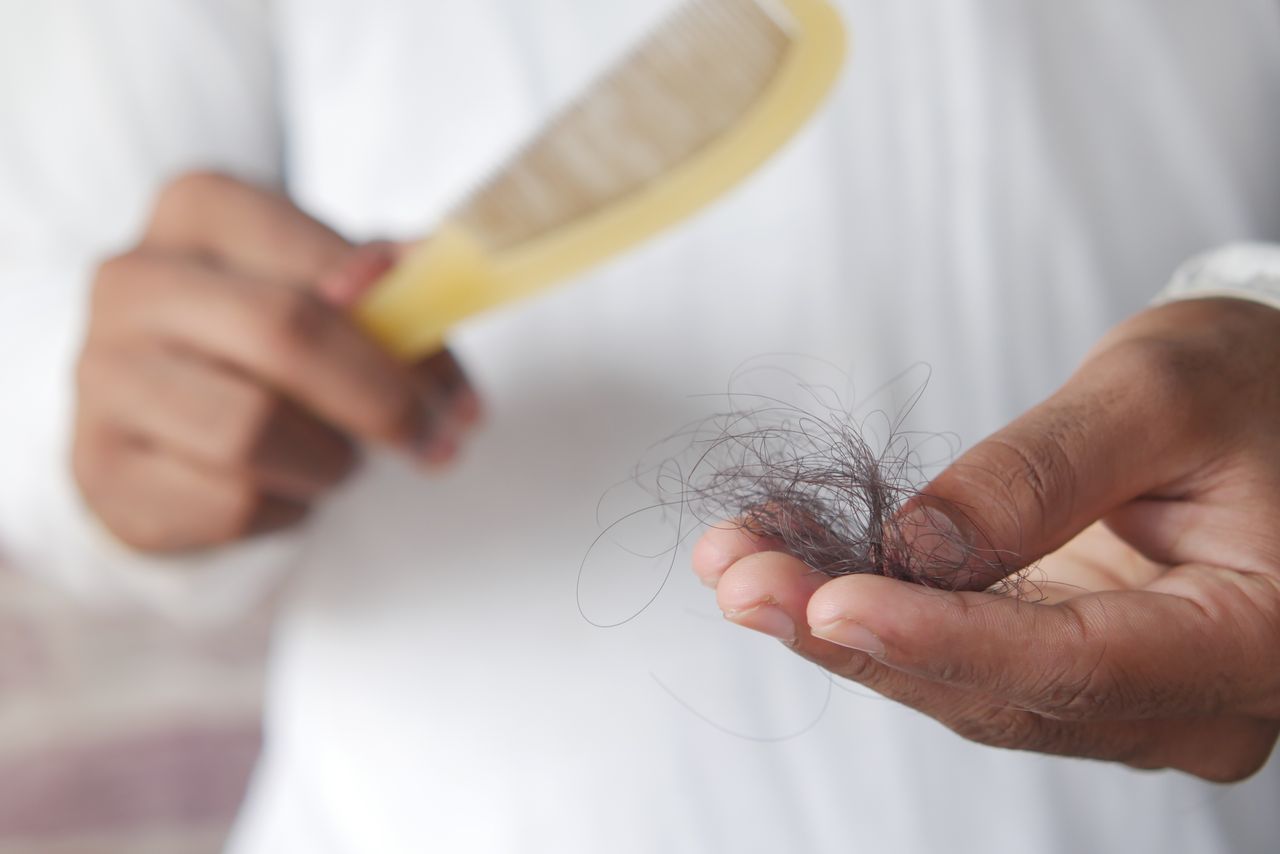

“My hair feels thinner than it used to. I’m finding more of it in the shower drain, on my pillow, in my brush. Is this just menopause, or is something else going on?”
Key Takeaways
- Hair thinning is common around menopause. Estimates vary widely between studies, but one study found that about half of postmenopausal women experienced female-pattern hair loss.
- The main drivers are falling estrogen, a shift in the balance between estrogen and androgens, and sometimes nutritional gaps.
- Female-pattern hair loss tends to get worse over time. Starting treatment early gives you the best shot at keeping the hair you have.
- The treatments with the strongest evidence are minoxidil and spironolactone, along with correcting real nutritional deficiencies.
- How you style your hair matters too. Consistently tight styles can pull hair out at the hairline, and that kind of loss can become permanent.
- Some types of hair loss cause scarring and need a dermatologist promptly.
- Hair loss in midlife is a real medical concern. It deserves attention and compassionate care.
—
You’re pulling more hair from the drain. Your ponytail feels thinner. You notice more of your scalp, yet few people discuss this change.
If this sounds familiar, you are not alone. And you are not imagining it.
Hair thinning around menopause is common. Many women start noticing changes years before their last period. Yet despite how common it is, many women never receive a diagnosis or treatment for hair thinning in midlife.
There are real reasons your hair is changing. And there are real options that can help.
What Is Menopause Hair Loss?
Menopause hair loss is the thinning and increased shedding that many women notice during perimenopause and after menopause. Hormonal changes, genetics, and sometimes nutritional shifts disrupt the normal hair growth cycle, leading to menopause-related hair thinning.
To understand why this happens, it helps to know how hair grows. Every hair moves through a cycle with three main phases:
– Anagen (growth phase): The follicle is actively making hair. This phase lasts about 2–7 years, and about 90% of your hair remains in it at any given time.
– Catagen (transition phase): A short phase of about 2–3 weeks. The follicle shrinks and growth stops.
– Telogen (resting and shedding phase): Lasts about 2–3 months. The old hair rests while a new one forms underneath, then falls out.
When something disrupts this cycle, more hairs shift into the resting phase and fall out, while fewer keep growing. The result is thinner, less dense hair.
Female-Pattern Hair Loss (FPHL)
This is the most common type of hair loss in women. It usually shows up as gradual thinning across the top and crown, often with a widening part. Most women keep their front hairline, though some also notice thinning at the front. Going completely bald is rare.
This process is known as follicular miniaturization. Over time, the follicles shrink and produce thinner, shorter, less visible hairs.
Female-pattern hair loss tends to be progressive, meaning it usually gets worse without treatment. That’s why catching it early matters so much.
Telogen Effluvium
This is widespread shedding set off by some kind of stressor: illness, surgery, rapid weight loss, a nutritional deficiency, thyroid problems, or major emotional stress.
It usually starts 2–4 months after the trigger. That delay is what makes it so confusing — by the time the shedding starts, whatever caused it may be long past.
The shedding can be dramatic. At its peak, people often lose more than 200 hairs a day. Once the trigger is addressed, it usually settles down within 6–9 months. If the trigger is still going on, the shedding can continue.
Some women have both female-pattern hair loss and telogen effluvium at the same time, which can make the thinning feel especially alarming.
One related note: if hair starts falling out within a couple of weeks of starting a new treatment — classically chemotherapy — that’s a different process called anagen effluvium, and the much faster timing is the giveaway.
How to Tell the Difference: Four Common Types of Midlife Hair Loss
| Feature | Female-Pattern Hair Loss | Telogen Effluvium | Iron-Related Hair Loss | Thyroid-Related Hair Loss |
|---|---|---|---|---|
| Pattern | Thinning at crown and part line | Shedding all over the scalp | Diffuse thinning all over | Diffuse thinning, often dry or brittle |
| Onset | Gradual, over months to years | Sudden, 2–4 months after a trigger | Gradual; may worsen with heavy periods | Gradual, often with other thyroid symptoms |
| Hair pull test | Usually normal | Often positive | May be positive | May be positive |
| Reversibility | Progressive without treatment, but can be stabilized | Usually reverses once the trigger is fixed | Correcting low iron may help shedding, though studies haven’t consistently shown regrowth | Usually improves once the thyroid is treated |
| Key lab finding | Labs often normal; diagnosis is clinical | Labs often normal unless a deficiency is the trigger | Low ferritin | Abnormal TSH and/or free T4 |
| Common triggers | Hormonal shifts, genetics | Stress, illness, nutritional gaps, thyroid problems | Heavy periods, low dietary iron, poor absorption | Underactive or overactive thyroid |
| Other clues | Widening part, hairline often preserved | Clumps in the shower or on your pillow | Fatigue, pale skin, shortness of breath, heavy periods | Fatigue, weight changes, temperature intolerance, dry skin |
| Typical age | Increases after 40; more common after menopause | Any age | Any age; common in perimenopause with heavy bleeding | Any age; more common in midlife women |
Many women have more than one type at the same time. A woman in perimenopause might have early female-pattern hair loss made worse by low iron from heavy periods. That’s exactly why a thorough evaluation matters.
What Causes Hair Loss During Menopause?
The hair follicle is sensitive to hormones. When the hormonal environment changes, the follicle responds.
Estrogen drops. Estrogen supports the growth phase and helps maintain hair thickness. As estrogen falls during the menopausal transition, that support fades. And it doesn’t happen all at once — estrogen fluctuates during perimenopause, which is why some women notice their hair changes come and go before becoming more constant.
The hormone balance shifts. Androgen levels actually decline with age, but because estrogen falls more sharply, the balance between the two shifts. In follicles that are genetically sensitive, this may contribute to miniaturization.
One important nuance: female-pattern hair loss is not simply the female version of male-pattern baldness. It’s more complicated, involving hormones, genetics, and environment, and it isn’t as clearly androgen-driven. Most women with female-pattern hair loss have completely normal androgen levels on blood work. That’s why labs can come back “normal” even when the hair loss is obvious.
Other Midlife Factors That Can Contribute
- Thyroid changes: Both underactive and overactive thyroid can cause shedding, and thyroid problems are more common in midlife.
- Iron deficiency: Low iron stores are common in women with heavy perimenopausal bleeding. Iron’s exact role in hair loss is still debated, but it’s worth checking.
- Vitamin D: Low levels are common with age, and some studies suggest a link with hair loss.
- Stress: Chronic stress can trigger or worsen telogen effluvium.
- Nutritional shifts: Restrictive dieting, rapid weight loss, or not enough protein can all disrupt the hair cycle.
- Sleep problems: Common in perimenopause, and they add to your overall stress load.
- Medications: Certain antidepressants, beta-blockers, retinoids, and blood thinners can contribute to shedding. Lithium is the most common medication cause of shedding.
One More Thing: How You Wear Your Hair
Washing your hair doesn’t cause hair loss. But how you style it genuinely can.
Pulling hair back tightly — day after day, year after year — puts real tension on the follicles along your hairline. This is called traction alopecia. The usual culprits are tight ponytails, buns, braids, locs, cornrows, weaves, and extensions.
Early warning signs are itching, tenderness, redness, or small bumps where the hair is pulled. Over time the hairline gets thinner and wispier, especially at the temples.
Here’s the part that matters most: caught early, it’s reversible. Left alone, the follicles scar and the hair won’t come back. If the area looks smooth and shiny with no visible pores where hairs should be, that’s a sign of permanent loss.
Chemically relaxed or heat-straightened hair breaks more easily, so chemical processing combined with tight styling is a higher-risk combination. Studies in African American women have also found braids and weaves significantly associated with more severe scarring hair loss, while relaxers and hot combs did not show the same clear link.
Traction alopecia can affect anyone but is most common in people with tightly coiled hair. It’s also been reported in Sikh men, in Japanese and Hispanic women, and in ballet dancers with tight buns.
One study of over 1,800 women also found that ponytail hairstyles were associated with more severe female-pattern hair loss. That’s an observational finding and can’t prove cause and effect, but it does suggest that styling tension isn’t irrelevant even to pattern thinning.
If you wear tight styles, loosening them, alternating with looser styles, and giving your scalp regular breaks is genuinely protective.
What Does the Research Say?
A 2025 review in Maturitas confirmed that the hormonal changes of menopause directly affect the hair follicle, and that female-pattern hair loss, telogen effluvium, and frontal fibrosing alopecia all occur more often in postmenopausal women.
A 2025 review in the New England Journal of Medicine reported that female-pattern hair loss rises from about 3–12% of women in their 20s and 30s, to 14–28% in their 50s, and up to 56% of women over 70. Those figures come mostly from women of European descent — rates appear lower in Asian women, and there simply isn’t good data in women of African descent, partly because a scarring condition called central centrifugal cicatricial alopecia can look similar in its early stages.
A study of 200 postmenopausal women found 52.2% had female-pattern hair loss, and a BMI of 25 or higher was linked to it independent of age and family history. Keep in mind that prevalence numbers vary widely between studies, largely because researchers use different definitions.
The Emotional Impact Is Real
Women with hair loss report more self-consciousness, shame, and emotional distress, and research has linked pattern hair loss to a meaningful hit to quality of life, especially emotionally.
Here’s something worth naming: how severe hair loss feels to you is often worse than what shows up on an exam. Even “mild” thinning can weigh heavily. That’s valid. It isn’t vanity.
Myth vs. Fact
| Myth | Fact |
|---|---|
| Washing your hair too much causes hair loss | Washing frequency doesn’t cause hair loss — you just notice more shedding on wash days. But styling does matter: consistently tight ponytails, buns, braids, locs, extensions, and weaves pull on the follicle and can cause traction alopecia, which becomes permanent if the styling continues |
| Only men get pattern hair loss | Pattern hair loss is common in women and becomes more common with age |
| Biotin will fix thinning hair | There’s little evidence it helps unless you’re actually deficient — and high doses can throw off thyroid and heart blood tests |
| Hair loss in menopause is just cosmetic | It’s a medical concern with real treatments |
| If your labs are normal, nothing can be done | Most women with FPHL have normal labs; treatments work directly on the follicle |
| You just have to live with it | There are effective treatments available |
Treatments That Work
Step 1: Find and Fix What’s Contributing
- Check thyroid function (TSH). One of the most common treatable causes of midlife hair loss.
- Check ferritin. Correct real iron deficiency with your provider’s guidance and follow-up testing. Some specialists aim higher than the standard lab cutoff, but iron should always be guided by labs, not guesswork.
- Check vitamin D.
- Review your medications for anything that might be contributing.
- Screen for excess androgens if there are clues — irregular periods, acne, unwanted facial hair, or darkened skin folds might warrant testing for PCOS. A male pattern of loss in a woman, or changes like a deepening voice, needs prompt evaluation.
Fixing these won’t always reverse hair loss by itself, but it creates the best foundation for other treatments to work.
Step 2: Medical Treatments
Topical minoxidil. The FDA-approved options for female-pattern hair loss are 2% solution twice daily and 5% foam once daily. Both produced hair growth in more than half of participants in a 48-week trial. Minoxidil extends the growth phase of the hair cycle.
A few practical notes:
- Once-daily 5% foam works about as well as twice-daily 2% solution, and many women find it easier to use with less scalp irritation.
- The 5% solution twice daily is approved only for men but is commonly used in women, and there is data suggesting it works better than the lower strength.
- It takes 3–6 months of daily use to see a difference, and the benefit lasts only as long as you keep using it.
- A brief increase in shedding in the first few months is common and is actually a good sign — resting hairs are being pushed out to make room for new growth.
- Some women get unwanted facial hair, which goes away if you stop.
Low-dose oral minoxidil. An off-label option that works well for women who find the topical version messy or irritating. One trial found 1 mg daily worked at least as well as 5% topical solution.
- Start low. For women, a starting dose of 1.25 mg a day or less is recommended, increasing slowly if needed. The usual range is 0.625–5 mg a day.
- Common side effects are extra hair growth on the face or body (reported in roughly 15–24% of people, depending on the study) and mild swelling in the legs or around the eyes. Both are dose-related and usually show up around 2–4 months.
- Blood pressure should be monitored.
- It shouldn’t be used if you have pericardial disease (a condition affecting the sac around the heart), uncontrolled high blood pressure, or if you’re pregnant. Extra caution is needed with kidney or liver problems.
- Fluid around the heart (pericardial effusion) is a rare but serious side effect. It’s uncommon at the low doses used for hair, but cases have been reported and the true rate isn’t known — which is a good reason to take this under supervision rather than from an unmonitored online source.
Spironolactone. An anti-androgen used off-label for female-pattern hair loss. It’s usually prescribed at 50–200 mg a day, and at least 100 mg a day appears to be needed for it to help hair.
- Common side effects include breast tenderness, irregular periods, lightheadedness on standing, and rising potassium levels, so potassium needs periodic checking.
- One 2026 study of 432 women taking spironolactone with low-dose oral minoxidil found side effects in about 38% — mostly extra hair growth and lightheadedness — and nearly all were mild and manageable. Women already on blood pressure medication had a notably higher risk of blood-pressure-related side effects.
- It must not be used in pregnancy.
- Worth knowing: while spironolactone is widely used and many women do well on it, there haven’t been large multicenter randomized trials of anti-androgens for female-pattern hair loss. Minoxidil has the stronger evidence base.
Finasteride and dutasteride. These block the conversion of testosterone to DHT and are used off-label in women.
- They must not be used by anyone who is or may become pregnant, because of the risk of birth defects.
- They also lower PSA levels, which matters if that test is ever ordered, and sexual side effects — including some that reportedly persist after stopping — appear in the product labeling.
Step 3: Add-On Options
These are worth considering if you want to boost your results or prefer to start with something other than medication. The evidence is stronger for some than others:
- Microneedling: Results as a standalone treatment are mixed, but most studies suggest it helps when combined with topical minoxidil. The studies so far have been small.
- Low-level light therapy (laser caps and combs): Well-designed studies comparing real devices to sham devices have shown increased hair density. Only a few devices are FDA-cleared, and they’re all sold directly to consumers.
- PRP (platelet-rich plasma) injections: Your own blood is drawn, processed to concentrate the platelets, and injected into the scalp. One trial in 30 women found 57% improved compared with 7% who got saline. A large review found positive results overall, though the findings weren’t precise. Important practical point: there’s no standardized way to prepare or inject PRP, so results vary from clinic to clinic — worth knowing if you’re paying out of pocket.
- Fractional laser treatment: Smaller studies of certain non-ablative lasers have shown increased density.
In most cases these work best alongside first-line treatments rather than instead of them.
A Note on Hormone Therapy
Hormone therapy isn’t prescribed for hair loss on its own. But if you’re a good candidate for it for other menopause symptoms, transdermal estrogen with a progestogen generally won’t make hair loss worse, and some women find their hair stabilizes.
Systemic testosterone is not recommended for women. Topical testosterone, when used with close monitoring for other reasons, doesn’t generally appear to harm hair.
What About Supplements?
- Iron: Helpful when your ferritin is genuinely low. Test first, and monitor.
- Vitamin D: Reasonable to correct if your level is low. Be aware, though, that there aren’t published studies showing how much hair actually regrows with vitamin D supplementation — so treat it as supporting your overall health rather than as a hair treatment.
- Zinc: May help if you’re deficient — but too much zinc can itself cause hair loss.
- Biotin: Little evidence it helps unless you’re deficient, and high doses can produce falsely abnormal thyroid and heart test results. Stop biotin before blood work.
- Collagen, keratin, and “hair growth” blends: Most don’t have strong evidence behind them.
Test first, supplement based on results, and skip the mega-doses.
When to See a Provider
Talk to your provider if you notice:
- Thinning at your part line or crown
- Shedding that’s lasted more than 2–3 months
- Clumps of hair coming out, or bald patches
- Hair loss along with fatigue, weight changes, irregular periods, or new acne or facial hair
- Thinning specifically along your hairline, especially if you wear tight styles
- Emotional distress about your hair
When to See a Dermatologist Right Away
- Scalp redness, tenderness, burning, or pain
- Scaling, crusting, or pustules
- Smooth, shiny patches where you can’t see any pores
- Eyebrow loss or a receding front hairline
- Bald patches that feel firm or scarred
These can be signs of scarring alopecia, including frontal fibrosing alopecia (the most common scarring hair loss in postmenopausal women) and lichen planopilaris. Unlike female-pattern hair loss, these can cause permanent loss. They usually need a scalp biopsy and dermatology care, and early treatment is critical.
Sudden patchy loss (which may be alopecia areata) or hair loss that isn’t responding to standard treatment also deserves a dermatology referral.
A Checklist to Bring to Your Appointment
- When did you first notice changes?
- Is the shedding all over, or in one area?
- Any recent stress, illness, or weight change?
- What medications and supplements are you taking?
- Family history of hair thinning?
- Other new symptoms (fatigue, mood changes, cycle changes)?
- Any scalp pain, redness, burning, or scaling?
- How do you usually style your hair, and how tightly?
- Anything you’ve already tried, and for how long?
You Don’t Have to Accept Menopause Hair Loss
Hair loss in midlife isn’t “just part of aging.” It’s a medical concern that deserves attention, compassion, and real care. Treatment works best when it’s started early, and a plan built around your particular mix of hormonal changes, nutrition, health history, and styling habits gives the best results.
If you’re noticing changes and want to understand what’s going on, schedule a consultation with Her Vital Wellness.
You deserve to feel like yourself again.
—
Frequently Asked Questions
Can menopause cause hair loss?
Yes. Falling estrogen and a shift toward relatively more androgen influence can disrupt the hair growth cycle. Rates climb with age — up to about half or more of women in later decades.
Is hair loss from menopause reversible?
Depends on the type. Telogen effluvium usually reverses once the trigger is fixed. Female-pattern hair loss is progressive, but treatment can slow it and sometimes improve density. Starting early gives the best results.
What’s the best treatment?
There isn’t one single best treatment. Topical minoxidil is the FDA-approved option and has the strongest evidence. Spironolactone, low-dose oral minoxidil, and correcting deficiencies are also commonly used. A personalized evaluation is the right place to start.
Does hormone therapy help with hair loss?
It’s not prescribed for hair loss alone, but if you’re a good candidate for other reasons, transdermal estrogen with a progestogen generally won’t make hair loss worse.
What labs should I ask for?
A reasonable starting panel: TSH, ferritin, vitamin D, and a complete blood count. Some specialists aim for a ferritin around 70 µg/L in women with active shedding, checked alongside an ESR — though that’s a recommendation rather than a proven target. Depending on your symptoms your provider might also check DHEA-S or testosterone.
Will biotin help?
Not unless you’re deficient — and high doses can distort thyroid and heart test results.
How much shedding is normal?
Roughly 50–150 hairs a day. In telogen effluvium it’s often more than 200 a day at its peak. If you’re consistently finding large amounts, or seeing visible thinning, bring it up.
Can tight hairstyles really cause hair loss?
Yes. Repeated tension from tight ponytails, buns, braids, locs, weaves, and extensions can cause traction alopecia, usually along the hairline and temples. Early on it’s reversible. If the styling continues, the follicles scar and the hair won’t grow back. Chemically relaxed or heat-straightened hair is more vulnerable.
Does stress make it worse?
Yes. Chronic stress can trigger or worsen telogen effluvium.
At what age does it start?
Many women notice changes in perimenopause, often in their early to mid-40s, with rates rising after 50.
Can diet affect it?
Yes. Low iron, vitamin D, zinc, and protein have all been linked to hair loss, and crash dieting can trigger telogen effluvium.
When should I see a dermatologist instead of my regular provider?
If you have signs of scarring alopecia — scalp redness, pain, burning, scaling, pustules, smooth shiny bald patches, or eyebrow loss. These can cause permanent loss and need specialized care, often including a scalp biopsy.
(Telehealth appointments are currently available for patients located in Arizona and New York.)
This information is educational and not a substitute for personalized medical care.
References
- Olsen EA. Hair loss in women. N Engl J Med. 2025;393(15). DOI: 10.1056/NEJMra2404548
- Gupta AK, Economopoulos V, Mann A, Wang T, Mirmirani P. Menopause and hair loss in women: exploring the hormonal transition. Maturitas. 2025.
- Chaikittisilpa S, Rattanasirisin N, Panchaprateep R, et al. Prevalence of female pattern hair loss in postmenopausal women: a cross-sectional study. Menopause. 2022;29(4). PMID: 35357365
- van Zuuren EJ, Fedorowicz Z, Schoones J. Interventions for female pattern hair loss. Cochrane Database Syst Rev. 2016;(5):CD007628.
- Rushton DH. Nutritional factors and hair loss. Clin Exp Dermatol. 2002;27(5):396-404. DOI: 10.1046/j.1365-2230.2002.01076.x
- Rushton DH. Management of hair loss in women. Dermatol Clin. 1993;11(1):47-53.
- Trost LB, Bergfeld WF, Calogeras E. The diagnosis and treatment of iron deficiency and its potential relationship to hair loss. J Am Acad Dermatol. 2006;54(5):824-844. PMID: 16635664
- Redler S, Messenger AG, Betz RC. Genetics and other factors in the aetiology of female pattern hair loss. Exp Dermatol. 2017;26(6):510-517. DOI: 10.1111/exd.13373
- Mirmirani P, Fu J. Diagnosis and treatment of nonscarring hair loss in primary care. JAMA. 2021.
- Akiska YM, Mirmirani P, Roseborough I, et al. Low-dose oral minoxidil initiation for patients with hair loss: an international modified Delphi consensus statement. JAMA Dermatol. 2025.
- Ong MM, Li Y, Lipner SR. Oral minoxidil for alopecia treatment: risks, benefits, and recommendations. Am J Clin Dermatol. 2025. PMID: 41118052
- Jimenez-Cauhe J, Lo Sicco KI, Shapiro J, et al. Characterization and management of adverse events of low-dose oral minoxidil treatment for alopecia: a narrative review. J Clin Med. 2025. PMID: 40142611
- Sinclair RD. Female pattern hair loss: a pilot study investigating combination therapy with low-dose oral minoxidil and spironolactone. Int J Dermatol. 2018;57(1). PMID: 29231239
- Kearney CA, Brinks AL, Lawrence CN, et al. Androgenetic alopecia in women: a narrative review of pathophysiology, clinical evaluation, and treatments. Am J Clin Dermatol. 2026;27(3). PMID: 41714473
- Wyche J, Senna M, Aguh C. Approach to scarring alopecia. JAMA Dermatol. 2025. DOI: 10.1001/jamadermatol.2025.0284
- Afifi L, Oparaugo NC, Hogeling M. Review of traction alopecia in the pediatric patient: diagnosis, prevention, and management. Pediatr Dermatol. 2021;38(6):1441-1447.
- Kyei A, Bergfeld WF, Piliang M, Summers P. Medical and environmental risk factors for the development of central centrifugal cicatricial alopecia: a population study. Arch Dermatol. 2011;147(8):909-914.
- Messenger AG, Sinclair R. Follicular miniaturization in female pattern hair loss: clinicopathological correlations. Br J Dermatol. 2006;155(5):926-930. DOI: 10.1111/j.1365-2133.2006.07409.x
- Grymowicz M, Rudnicka E, Podfigurna A, et al. Hormonal effects on hair follicles. Int J Mol Sci. 2020;21(15):5342. DOI: 10.3390/ijms21155342
- Blume-Peytavi U, Blumeyer A, Tosti A, et al. S1 guideline for diagnostic evaluation in androgenetic alopecia in men, women and adolescents. Br J Dermatol. 2011;164(1):5-15. DOI: 10.1111/j.1365-2133.2010.10011.x
- Dakkak M, Forde KM, Lanney H. Hair loss: diagnosis and treatment. Am Fam Physician. 2024;110(4):401-410.
- Mesinkovska NA, Bergfeld WF. Female pattern hair loss update: diagnosis and treatment. Dermatol Clin. 2013;31(1):119-127. DOI: 10.1016/j.det.2012.08.005
- Fabbrocini G, Cantelli M, Masarà A, et al. Female pattern hair loss: a clinical, pathophysiologic, and therapeutic review. Int J Womens Dermatol. 2018;4(4):203-211. DOI: 10.1016/j.ijwd.2018.05.001
- Atanaskova Mesinkovska N, Bergfeld WF. A systematic review of the effect of androgenetic alopecia on quality of life. JAMA Dermatol. 2013;149(10).
- Almohanna HM, Ahmed AA, Tsatalis JP, Tosti A. The role of vitamins and minerals in hair loss: a review. Dermatol Ther. 2019;9(1):51-70. DOI: 10.1007/s13555-018-0278-6
- Vary JC. Selected disorders of skin appendages: acne, alopecia, hyperhidrosis. Med Clin North Am. 2015;99(6):1195-1211. DOI: 10.1016/j.mcna.2015.07.003
- The Menopause Society. Menopause practice: a clinician’s guide. 7th ed.